Does hard water cause drain problems, or only water heater problems?
The bathroom sink used to run fine. Now it drains a little slower each month. That slow creep is the sign of scale, not a clog.
Hard water does more than coat a water heater. Minerals from the supply side leave a chalky layer inside a trap. In a bathroom line they bind with soap residue into a hard, grey film. The bore narrows a fraction at a time, so you notice a gradual slowdown rather than a sudden blockage.
Old cast iron is a different problem. Inside drain pipe that has been in the ground or a wall for decades, rust forms lumpy mounds called tubercles. These are not hard-water minerals. They are the pipe corroding from within, and they snag grease and paper.
The two tools do different work. A cable punches a hole through the build-up. Water drains again, but the scale stays on the wall and the line narrows again. Hydro jetting strips the wall back to the pipe surface.
Jetting old iron hard without looking first is a gamble, because thin, flaking pipe can fail under pressure. That is why a camera inspection comes first on old iron. It shows wall condition and cracks before anyone sets the pressure.
Safe homeowner check: find out whether one fixture is slow or every drain in the house is, then clean the visible stopper and trap.
Stop running water and call now if several drains slow together, or water backs up at a floor drain. One slow bathroom sink is usually a cable or trap job. A whole-house slowdown in old iron often needs a camera first and possibly jetting.
Expert Plumbers Co is a referral service. We connect you with an independent local plumber in Fields Landing, CA. Call (380) 262-9173.
A water softener changes the picture a little, and it is worth telling the plumber if you have one. Softened water leaves less mineral scale, but it can feel slippery and does not stop soap and hair from building up on the pipe wall. If your water is hard and you have no softener, the mineral film inside traps and short branch lines is the main cause of the slow creep. A simple habit helps: use a hair catcher in the tub and basin, and rinse the sink with hot tap water after use so soap does not cool and settle on the wall. Do not rely on vinegar or store-bought descalers to clear a drain, as they only treat the surface. In newer homes with plastic pipe, scale is mostly a trap and fixture issue. In older homes with iron or galvanized pipe, scale and corrosion together can narrow a line enough that replacing a section is more sensible than repeated cleaning.
The street sewer backed up into my house. What is a backwater valve?
Sewage came up through the basement floor drain, or a low toilet or tub gurgled and overflowed, during a storm or a heavy-use evening.
The usual cause is the municipal main in the street filling past capacity, called surcharging. With nowhere to go, the flow pushes back up the lateral and out of the lowest opening in the house.
A backwater valve, also called a check valve, is a fitting on the lateral or building drain with a flap that lets waste leave and shuts when flow reverses. It sits on the line ahead of the branches serving the lowest fixtures.
Fitting one is not a quick swap. It usually means opening the floor or digging to reach the pipe. What it involves depends on access, the depth of the line, the valve and materials, how much has to be opened up and restored, and whether a permit or code sign-off is required. Rules vary by area.
A valve does not fix roots at a clay joint or a bellied line holding water. It only stops reverse flow. A private line problem needs a camera inspection first, then a cable machine or hydro jetting depending on what the camera shows.
Street or private? Ask three things. Are the neighbors affected? Did it coincide with heavy rain? Is only the lowest opening backing up while upper fixtures drain normally? Yes to those points to the street main. Only your house, in dry weather, points to your own lateral.
Safe homeowner check: look at the neighbors and the forecast. Stop running water now: no flushing, washer or dishwasher. Keep people and pets out of contaminated water, and call.
Expert Plumbers Co is a referral service. We connect you with an independent local plumber in Fields Landing, CA. Call (380) 262-9173.
After the cleanup, ask how the valve will be kept working. The flap and its hinge can be stopped by lint, grease and grit, and then it no longer seats fully. Most valves have an access cover so the flap can be looked at and cleaned, and that should be done on a routine, not only after a storm. Learn where the cover is and keep boxes and floor coverings off it.
One point catches people out. With the valve closed during a storm, your own household water has nowhere to go either. Showers, sinks and the washer will fill the line behind the flap, so keep water use low until the street main drops.
After any backup, the floor drain and the area around it need to be cleaned and disinfected. Porous materials that soaked up sewage, such as carpet pad and cardboard, usually have to be removed rather than dried.
Two houses share one sewer line. Whose blockage is it?
Your basement drain is backing up and the neighbor says theirs is fine. Or both are backing up and each blames the other. On a shared sewer lateral, that argument is common.
In older terraced or paired properties, two buildings join one lateral before it reaches the main. A blockage downstream of that junction backs up into whichever building sits lower. That is often not the building that caused it. Roots at a clay joint, grease build-up or a bellied line can sit past the junction and still flood one side.
One slow sink is local, and a cable machine usually clears it. Every drain in the building backing up points to the lateral. That calls for a camera inspection, and often hydro jetting.
A camera inspection and a locator establish where the junction is and where the blockage point sits. Distance readings matter: how far from the cleanout to the junction, and to the fault. They show which side of the junction the fault is on.
Responsibility depends on local rules and on where the fault sits. Some places treat the shared section as a joint matter for the owners, others place part of it with the utility. Do not assume. The city or sewer utility can say how it works for a given address.
Safe homeowner check: ask the neighbor if they have symptoms, and hold off on water use. Stop running water and call now if sewage is rising in a tub, shower or floor drain. What a repair involves depends on access, the materials, how much has to be opened up, and any permit or code requirement.
Expert Plumbers Co is a referral service. We refer homeowners in Fields Landing, CA to an independent local plumber for Drain Cleaning and Emergency Drain Cleaning. Call (380) 262-9173.
Before anyone argues about cost, get the facts in hand. Agree with the neighbor to share the camera footage and the distance readings, so both households work from the same picture. Check the property records for any easement or shared-line agreement, since some older properties carry one. Ask the local building department or sewer utility who maintains the section between the junction and the main.
Ask your home insurer whether sewer backup is covered. Many policies treat it as an optional add-on, and a claim usually needs documents.
Once the line is clear, the sensible follow-up is a maintenance plan both sides accept. That might be periodic jetting, or a cleanout fitted at the junction so future blockages can be reached without digging. A cleanout in the right spot turns a future emergency into a short job. Keep the plumber's written findings. They settle most disputes about where the fault sat.
Is this a water supply problem or a drain problem?
Water that will not leave is a drain problem. Water that arrives wrong is a supply problem.
Supply problems show up as weak pressure, water that runs hot or cold when it should not, a meter that keeps turning, or a wet spot where the water is clean. Drain problems show up as water that will not go down, gurgling, a sewer smell, or dirty water coming back up through a tub or floor drain. A jump in the water bill points to supply, not drainage.
A wet patch in the yard can be either. The giveaway is the water itself. Clean and odorless points to a supply leak. Gray, dark or smelly points to a drain, often a failed sewer lateral or a root-damaged joint.
Safe homeowner check: shut off every fixture and appliance, then look at the meter dial. If it still turns, water is escaping somewhere. Next, run one drain at a time and note which ones are slow.
One slow fixture is its own branch line, and a cable machine often clears it. Several fixtures slow together point to the main line or a blocked vent stack. A repeat problem can need a camera inspection or hydro jetting instead of a cable.
Stop running water and call now if sewage is coming up in a tub or floor drain, if every drain in the house is backing up, if a clean leak will not stop, or if water is near electrical equipment.
What the work involves depends on access, the pipe materials, how much has to be opened up, and any permit or code requirement. Expert Plumbers Co is a referral service. Call (380) 262-9173 and we will refer you to an independent local plumber in Fields Landing, CA.
Two cases fool people. The first is a toilet that keeps refilling. It wastes supply water, yet it can look like a drainage fault because water is always moving. Listen for a hiss when the house is quiet, then put a little food coloring in the tank. Color in the bowl without flushing points to a worn flapper.
The second is a hot water line leaking under a slab. Signs include a warm patch on the floor, a water heater that seems to run constantly, or the sound of water with every fixture off. That is a supply problem and needs a different approach from drain cleaning.
Pressure tells you something as well. Low pressure on hot water only points at the water heater or its valves. One weak fixture often means a clogged aerator or a partly closed shutoff, usually from mineral scale. Note which case fits before you call, so the right tools and parts come with the plumber.
There is a soggy strip, a sinkhole or an unusually green line of grass over where my sewer runs. Is that a broken sewer line?
It can be. A wet strip, a dip in the lawn or a stripe of grass that is greener than the rest, all following the path of the sewer, is a classic sign that the pipe is leaking into the soil. Waste water carries nutrients, so the grass above it grows lush while the ground underneath stays soggy.
A sinkhole is more serious. If soil is washing into a cracked or separated pipe, it leaves a void that grows over time. The surface may look fine until the roof of that void gives way. Keep people, pets and vehicles off the area and do not fill it yourself with a quick load of dirt, because the hole will usually return.
Other things can look similar, so check before assuming. A leaking irrigation line, a broken water supply pipe or a downspout discharging at that spot can all soak a strip of lawn. A simple test: shut off every tap and appliance, then look at your water meter. If it keeps moving, the leak is likely on the supply side, not the sewer. If the meter is still, and you also notice slow drains, gurgling, a sewage smell outdoors or backups, the sewer is the stronger suspect.
Safe checks you can do:
Note where the wet or green strip runs and whether it lines up with the cleanout or the path to the street. Reduce water use until the line is looked at.
Stop running water and call now if sewage is surfacing, a hole is opening, or drains inside the house are backing up.
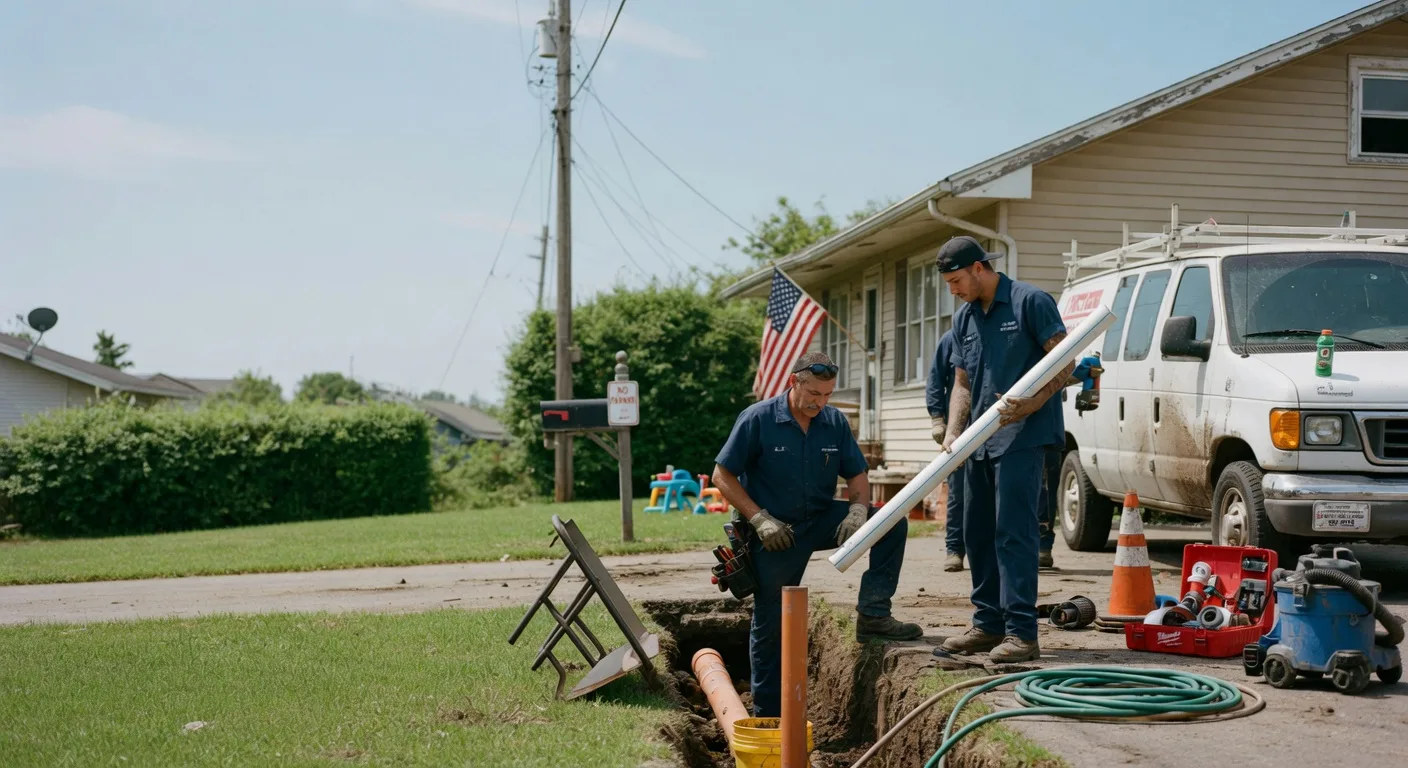
Cleaning alone does not fix a broken pipe. A camera inspection is how a plumber finds the break, shows how far the damage runs and tells whether the pipe is cracked, offset at a joint or collapsed. Repair can then be a spot repair, a liner through the existing pipe, or replacement of a section. Cost is driven by depth, length of pipe affected, what sits on top of it such as a driveway, trees or a patio, how much has to be excavated, the pipe material and permits under local code. To be connected with an independent local plumber in Fields Landing, CA, call Expert Plumbers Co on (380) 262-9173.